
In short
The calculator covers five job types: house or building, interior strip-out, industrial building, outdoor work including built pools, and rubble only. It returns an indicative range before VAT, not an offer; the binding price is the written quote we prepare after seeing photos, measurements or the site.
Demolition calculator
Indicative range, VAT not included. Not an offer: the binding quote is given in writing after seeing the job.
Contents
What does the demolition calculator do?
The demolition calculator gives you an order of magnitude for your job before you contact anyone: you choose the type of work, enter quantities and receive a rounded range with VAT not included. It exists because the first decision most owners face is not which contractor to hire but whether the project makes sense at all this year.
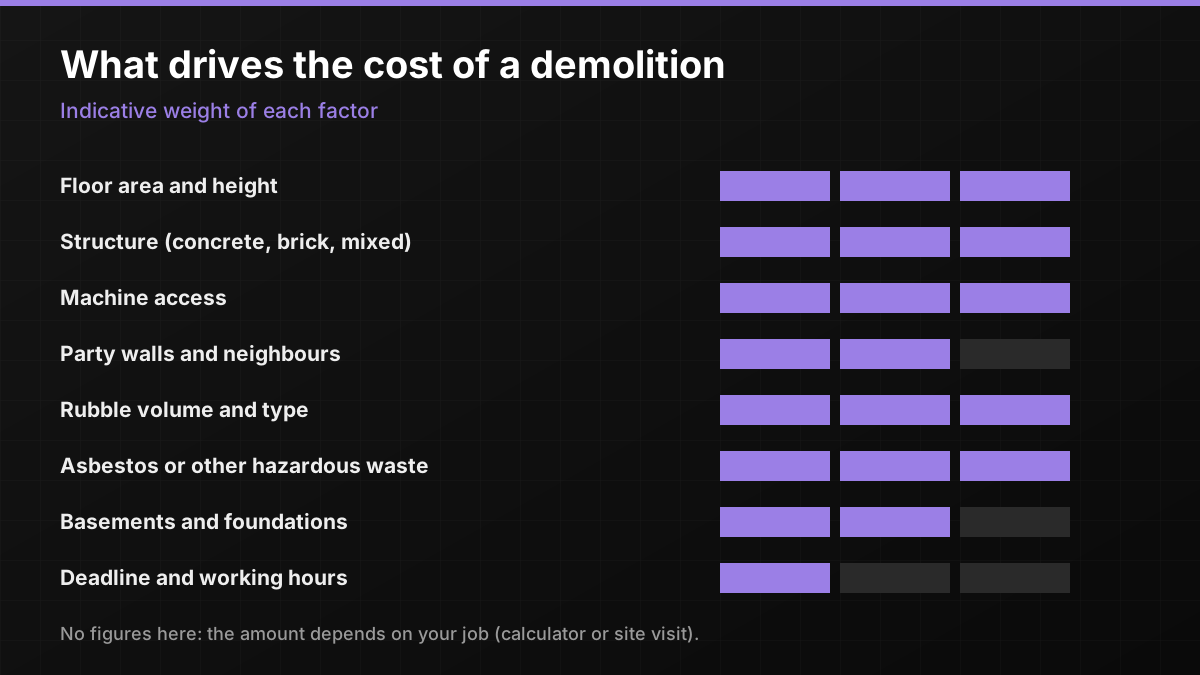
Behind the form there is the same logic we use when pricing a job by hand: a base rate for each kind of work, adjusted for the factors that move cost most, such as difficult access, a basement or a uralita roof; the number of floors is used to flag buildings that need a site check. The result is deliberately rounded and given as a band, because quoting a precise number from five fields would suggest an accuracy that does not exist. For the reasoning behind each line of a real quote, read how a demolition quote is built.
Which job types and fields does the calculator use?
The calculator is split into five tabs. Pick the one that matches the main part of your job; if you have several, run each tab separately and keep the results together.
| Tab | What you enter | Typical use |
|---|---|---|
| House or building | Built floor area to demolish, number of floors, technique and access (standard excavator, difficult access, large volume), basement, uralita or fibre cement | Villas, chalets, townhouses, old cortijos, small blocks |
| Interior strip-out | Partitions, openings in load-bearing walls (with your engineer's design), new door or window openings, wall and floor tiles, false ceilings, plaster chipping, sanitaryware, baths and trays, rubble to carry down, floor level | Apartment and villa refurbishments, shops and offices |
| Industrial building | Footprint, steel frame or mixed steel and concrete, concrete slab included or not, uralita roof | Warehouses, workshops, agricultural sheds |
| Outdoor, concrete and pool | Unreinforced or mesh-reinforced slabs up to 10 cm, terraces and paving, block or brick walls by face area, built pool shell area | Gardens, patios, driveways, garden walls, pools |
| Rubble only | Number of skips | Rubble already on site that needs to go |
Every field accepts approximate values. It is better to enter a reasonable estimate than to leave a field empty, because an empty field counts as zero and the range will come out too low.
How do you measure your job for the calculator?
Measure what will actually be demolished, not the size of the plot or the price you paid for the property. Most wrong estimates come from mixing up those quantities.
- Built floor area: add up every floor that will be demolished. A two-storey villa with a footprint of a given size has roughly double that floor area. The catastro record or your plans usually give a figure you can use.
- Pool shell: enter the floor plus the walls of the vessel, not only the water surface. A rough way is length times width for the floor plus the perimeter times the average depth for the walls.
- Walls: the calculator asks for face area, which is length times height on one side.
- Slabs and terraces: length times width. If you know there is steel mesh in the concrete, choose the reinforced option; if you are unsure, run both and note the difference.
- Interior rubble: if you do not know the volume, leave it to us and fill in the elements instead; the floor level matters because carrying rubble down stairs is slow work.
The guide the information we need to quote your demolition shows how to take photos and measurements that also serve for the written quote, so the work you do here is not wasted.
Why is the result a range and why is VAT not included?
The result is a range because the same quantities can hide very different jobs, and the calculator cannot see your site. Access, the state of the structure, how cleanly the waste can be sorted and the distance to an authorised facility all shift the final figure, and the band reflects that uncertainty honestly.
VAT is left out because the rate is not the same for every client. Demolition work is generally taxed at the standard 21 % IVA, but certain renovation or repair works on private homes may qualify for 10 % if the conditions of the Ley del IVA are met. Rather than guessing, the calculator shows the net range and the written quote states the rate that applies to your case.
When is the calculator not enough?
Skip the calculator and ask directly for a quote when the job has features that the form cannot describe. In those cases the range may be misleading in either direction.
- The building shares a wall with a neighbour, or stands right on a narrow street or a steep slope.
- There is a basement, a retaining wall or a foundation you have never seen.
- You suspect asbestos beyond a simple roof: pipes, tanks, panels or flooring.
- The building is in a historic centre or may be protected, so the procedure and the method may be different.
- The job is in an apartment block and the rubble has to come down through common areas.
- The site is full of mixed waste from earlier works that will be hard to sort.
The post who the demolition calculator is for, and when it isn't enough goes through these cases with examples. For cost per square metre in particular, the page demolition cost per m² explains why the same floor area can produce very different ranges.
From the calculator range to a written quote
Once you have a range that fits your plans, the next step is a written quote. Send us the photos and measurements you used, mention the range you obtained and tell us your timing; we then reply with questions, a proposal to see the site or the quote itself.
The written quote replaces the range with a figure for your specific job, itemised by scope, method, waste handling and site condition at the end, with the exclusions listed and the VAT shown separately. It is without obligation, and you can use it to compare other offers line by line. Use the demolition quote request or go to the quote page; if your job includes a pool, our sister site explains the technical options in pool demolition.
Frequently asked questions
Is the demolition calculator accurate?
It is accurate enough to tell you the order of cost, which is its purpose. The real figure depends on access, structure and waste details that only show up in photos or on site.
Do I have to give my e-mail to see the result?
No. The range is shown on the page. You only send your details if you decide to ask for a written quote.
Why does the range not include VAT?
Because the rate depends on the job and the client: generally 21 % IVA, with 10 % possible for some works on private homes if the legal conditions are met. The quote states it.
Can I use the calculator for a job with several parts?
Yes. Run each tab separately, for example the house and then the pool, and keep the ranges together. A combined quote is often lower than the sum because machinery is mobilised once.
What if I don't know the floor area?
Use the catastro record or your plans, or measure the outside of the building and multiply by the number of floors. An approximate figure is better than none.
Does ticking 'has uralita' cover the asbestos removal?
It adds an allowance for an asbestos phase to the range. The real cost depends on the quantity and position, and the work is done by a RERA-registered company working as our subcontractor.
What does 'difficult access' mean in the calculator?
That a standard excavator and lorry cannot reach the building, so the work is done with a mini excavator or by hand and the waste is moved in smaller loads.
Is the calculator range a commitment from you?
No, it is indicative and not an offer. The binding price is the written quote.
Can I send you my calculator result?
Yes, mention it when you ask for a quote together with photos and measurements; it helps us understand what you expect.
Does the calculator work for pool infill?
Use the outdoor tab and enter the pool shell area. Whether you choose full removal or infill changes the job, which the written quote then reflects.