In short
A first demolition quote follows eight steps: define what you want to achieve, gather plans and photos, run the calculator for a range, send a complete request, answer follow-up questions or arrange a visit, receive an itemised written quote, check it against your técnico's documentation and sign once the procedure is clear.

Contents
- Step 1: decide what the demolition is for
- Step 2: gather the documents and photos you already have
- Step 3: run the calculator to see the order of magnitude
- Step 4: send one complete request
- Step 5: answer questions, or arrange a visit
- Step 6: read the written quote properly
- Step 7: check the quote against the paperwork
- Step 8: sign, schedule and stay informed
- Frequently asked questions
Step 1: decide what the demolition is for
Before you ask anyone for a price, write down in one or two sentences why the demolition is needed. «Clear the plot for a new house», «remove the old pool and terrace, keep the villa», «strip the flat back to the structure for a full renovation» and «take down an unsafe outbuilding» lead to very different quotes.
The purpose decides the scope: what goes, what stays, whether foundations are removed, and how the site should be left. It also tells you who else is involved. A new build almost always means an architect already working on the project; a strip-out may mean a builder who will follow; an unsafe structure may need a técnico urgently. If you are unsure whether to renovate or rebuild, settle that question first, because it changes everything that follows.
Step 2: gather the documents and photos you already have
Owners usually have more useful information than they think. Collect, in one folder:
- plans, the catastro sheet or the property's technical documentation, if available;
- photos of each façade, the roof, the inside of each room or level, the garden, the pool and outbuildings;
- photos of the access: the street, the gate, any lane, ramp or tight bend;
- anything that might be fibre cement: corrugated roofs, flat panels, flues, water tanks, pipes;
- the municipio and, for a flat or a complex, the name of the community administrator.
If you are abroad, a neighbour, agent or property manager can take the photos for you. Wide shots from a distance are more useful for pricing than close-ups of details.
Step 3: run the calculator to see the order of magnitude
The calculator answers the first practical question: is this a small, medium or large outlay? Pick the job type, enter the floor area, floors and the yes/no questions, and you get a rounded range with VAT not included.
Use the range for decisions, not for contracts. It helps you decide whether to go ahead, whether to talk to your architect about keeping part of the building, or whether to wait a season. The page how the demolition calculator works explains what each input does, and for a flat or premises the interior demolition cost page covers the factors that matter indoors.
Step 4: send one complete request
With your folder ready, send the request once, completely. Through the quote request form, by e-mail or by WhatsApp, include the purpose from step 1, the photos and plans from step 2, the calculator inputs from step 3 and the dates you have in mind.
Mention who your técnico is if you already have one, and whether the técnico's documentation is in progress. It helps us align the quote with the project and, later, coordinate the dates. You can write in English; there is no need to translate your documents.
Step 5: answer questions, or arrange a visit
For a simple job, good photos may be enough to go straight to a written quote. More often there are a few questions: the thickness of a slab, whether a wall is shared, what is under a terrace, how a lorry turns at the gate. Short answers, with an extra photo where useful, keep the process moving.
For whole houses, basements, steep plots, party walls or suspected asbestos we normally need to see the site. If you are not in Spain, someone with the keys can meet us. A visit is not a sales pitch: it is where the range from step 3 becomes a figure, and where the method is decided.
Step 6: read the written quote properly
The written quote is the first document you can rely on. A good one is specific to your property and answers five questions without you having to ask:
- Scope: exactly what is demolished and what is kept.
- Method: manual, mechanical or combined, and how neighbouring structures are protected.
- Waste: sorting on site, transport, delivery to an authorised facility and the delivery receipts you will receive.
- Exclusions: what is not included, such as the técnico's documentation or the municipal procedure.
- Money: the total, any unit rates for unknowns, the VAT rate and the payment stages.
If something is unclear, ask before you sign. The guide how a demolition quote is built explains each part, and the house demolition cost page shows the factors behind the figures.
Step 7: check the quote against the paperwork
Before you accept, compare the quote with your técnico's documentation. The scope in the quote should match the scope in the proyecto or memoria técnica, and the waste handling should be consistent with the estudio de gestión de residuos. If the técnico's project says the slab stays and the quote says it goes, one of them has to change.
At this point you should also know which procedure applies: a declaración responsable for most buildings that are not protected, or a licence for protected buildings and settings. You and your técnico file it with the ayuntamiento; we do not. If a skip or lorry will stand on the public road, an authorisation to occupy it is needed too.
Step 8: sign, schedule and stay informed
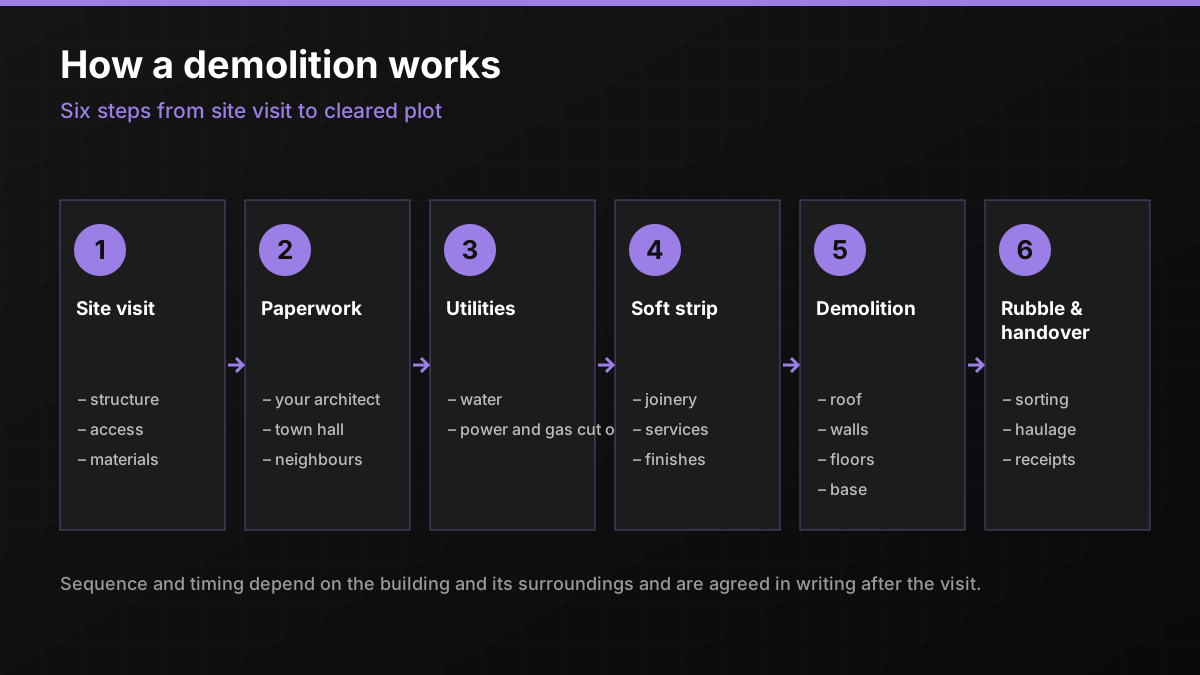
Once the quote matches the project and the procedure is in hand, you accept it in writing and agree the start date. We coordinate dates with your técnico, and on site the job follows the sequence our sister site describes in demolition step by step. If you are abroad, agree how you will be kept informed, usually photo updates by WhatsApp or e-mail at each stage, which also lets you confirm milestones before stage payments.
At the end, the site is left in the agreed condition and you receive the waste delivery receipts with the final invoice. Keep them: they are the proof that the waste reached an authorised manager, and they are what the town hall looks at when returning the waste guarantee. If you want to see the whole list of what can go wrong along the way, read mistakes when asking for a demolition quote from abroad.
Sources
Frequently asked questions
What is the first step to get a demolition quote?
Decide what the demolition is for and write down what goes and what stays. The purpose determines the scope, and the scope determines the price.
What documents do I need for a demolition quote?
Plans or the catastro sheet if you have them, photos of every façade, the roof, the interior, the garden and the access, and the municipio. Nothing has to be translated.
Should I use the calculator before asking for a quote?
It is a good idea: the range tells you the order of magnitude and helps you decide whether to proceed. It does not replace the written quote.
Is a site visit always necessary?
No. Simple jobs can often be quoted from photos. Whole houses, basements, steep plots, shared walls or suspected asbestos usually need a visit.
Can someone else meet you at the property?
Yes. A neighbour, agent or property manager with the keys can meet us on site if you are abroad.
What should a written demolition quote contain?
The scope, the method, the waste route with delivery receipts, the exclusions, the total with any unit rates, the VAT rate and the payment stages.
When should I sign the quote?
Once it matches your técnico's documentation and the municipal procedure is clear. Signing earlier is possible, but the start date depends on the paperwork.
Do you file the declaración responsable?
No. You and your técnico file it with the ayuntamiento. We can tell you which documentation the ayuntamiento usually asks for and coordinate dates with your técnico.
How will I know the job is progressing?
We agree a way of keeping you informed before the start, usually photo updates by WhatsApp or e-mail at each stage.
What do I receive at the end of the job?
The site in the agreed condition, the final invoice and the waste delivery receipts, which prove that the waste reached an authorised manager.