In short
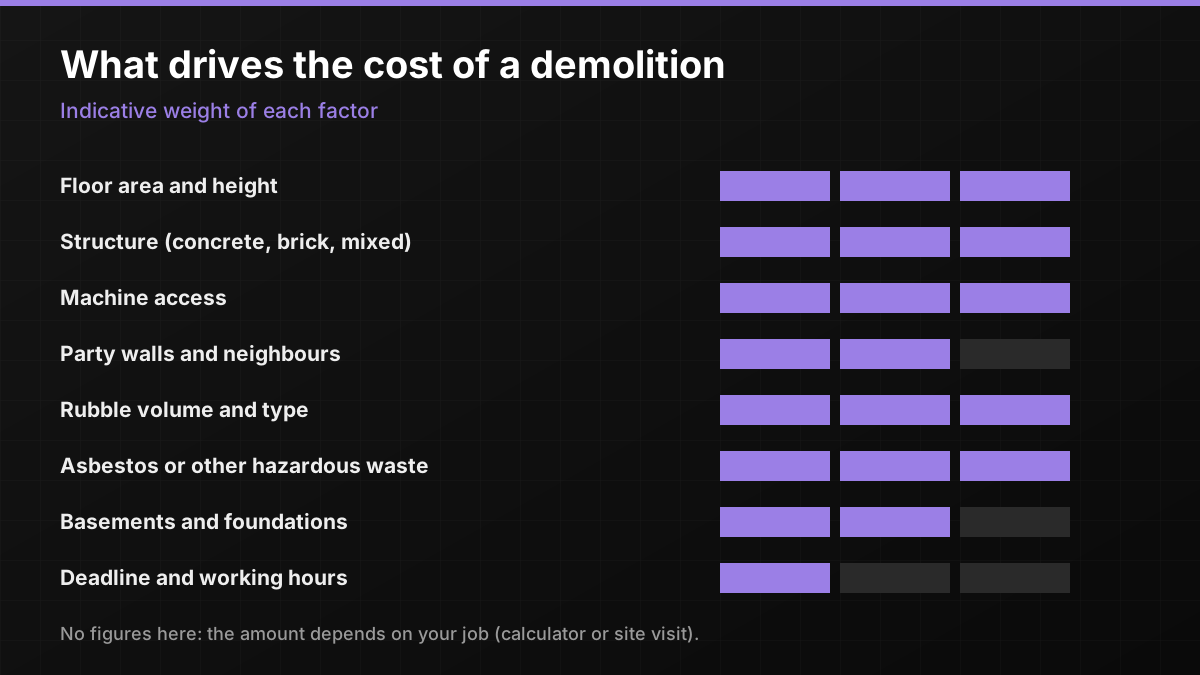
A demolition cost per m² divides a total by an area, but it does not say which area (built, footprint or plot), what the structure is made of, how many floors and basements there are, how the site is reached or what happens to the waste. Two buildings with the same area can differ several times over in real cost. Use per-m² figures only to compare similar jobs, and always ask what the figure includes.

Contents
- What does a demolition price per m² actually measure?
- Which square metres: built area, footprint or plot?
- How structure and height change the cost behind each square metre
- Basements, foundations and the work you cannot see
- Access, neighbours and waste: costs that do not scale with area
- When is a per-m² figure genuinely useful?
- How to test any per-m² offer in four questions
- Same area, different job: two illustrative cases
- Frequently asked questions
What does a demolition price per m² actually measure?
A price per square metre is a total cost divided by an area, nothing more. It describes the result of a calculation, not the calculation itself, which is why it can be correct for one building and wrong for the one next door.
Contractors use it as shorthand because it is easy to communicate. The real quote, however, is built from machine days, crew days, tonnes of waste, transport and protection, as described in how a demolition quote is built. Dividing that total by an area gives a number that looks precise but carries none of the information that produced it.
The rest of this guide goes through the five things a per-m² figure hides, then shows when the unit is genuinely useful.
Which square metres: built area, footprint or plot?
The first trap is that three different areas get called "the square metres" of a property, and a per-m² price means something different with each of them.
| Area | What it is | Effect on a per-m² price |
|---|---|---|
| Built floor area (superficie construida) | The sum of every floor, measured to the outside of the walls | The most meaningful basis for building demolition |
| Footprint (superficie en planta) | The ground area the building covers | For a multi-storey building it understates the volume, so the rate looks higher |
| Plot area (superficie de parcela) | The whole parcel, including garden, drive and pool | Mixes building and outdoor work; almost useless for comparison |
The catastro record usually gives a built area, but it may not include later additions, terraces or outbuildings. Before you compare per-m² figures, make sure every contractor is using the same area and that it matches what will actually be demolished.
How structure and height change the cost behind each square metre
A square metre of a light single-storey house and a square metre of a reinforced concrete block are not the same amount of work. The structure decides which tools are needed and how much material each metre contains.
- Load-bearing brick with light floors comes down relatively quickly and produces mostly mineral waste.
- Reinforced concrete frames need breakers, crushers or shears, take longer per metre and produce concrete and steel that must be separated.
- Height adds controlled top-down work, protection against falling debris and, in tall buildings, long-reach equipment or manual work on upper floors.
So a per-m² figure that is reasonable for a bungalow on the coast can be far too low for a three-storey concrete villa, even though both are "houses". Our sister site describes the techniques for heavier structures in concrete demolition.
Basements, foundations and the work you cannot see
A per-m² price for "the house" rarely says what happens below ground, and below ground is where many quotes diverge. A basement is a box of walls and slabs, often holding up the soil around it, and it can produce as much waste as a floor above ground.
The questions to ask are simple:
- Is the ground slab included, or does the price stop at ground level?
- Are footings and foundations removed, and to what depth?
- If there is a basement, is it demolished, filled or left, and what supports the surrounding ground?
- Are cisterns, septic tanks or buried services part of the scope?
Two offers with the same per-m² rate, one stopping at ground level and the other clearing the foundations, are not comparable. The guide what's included in a demolition quote and what isn't lists the grey areas to clear up.
Access, neighbours and waste: costs that do not scale with area
Some of the largest cost drivers have nothing to do with the size of the building. They depend on where it stands and what it leaves behind.
- Access. A narrow lane, a steep drive or a gate too small for an excavator means smaller machines, more hand work and more trips.
- Neighbours. A shared wall, a nearby road or an adjoining roof calls for propping, protection and slower sequencing.
- Waste mix. Clean fractions cost less to deliver than mixed rubble; old extensions built with mixed materials can push the price up.
- Asbestos. A uralita roof adds a separate phase carried out by a RERA-registered company, which a generic per-m² rate does not include.
- Fixed costs. Mobilisation and set-up cost roughly the same for a small and a medium job, so the per-m² rate of a small demolition is naturally higher.
This last point surprises many owners: a small outbuilding often has a higher price per m² than a large villa, simply because the fixed costs are shared over fewer metres.
None of these costs can be read from a floor plan. They appear in photos of the access, the street and the roof, or on a short visit, which is why a quote prepared from those sources is more useful than any rate quoted by phone.
When is a per-m² figure genuinely useful?
A per-m² figure is useful when it is used to compare like with like: the same kind of structure, similar access and the same scope. In that situation it tells you whether an offer is in line with others or out of step.
It is also a fair way to price repetitive, uniform work, for example removing floor tiles in an apartment, demolishing a slab of known thickness or stripping a false ceiling, where each metre really does involve about the same effort. The page demolition cost per m² explains where the unit works and where it does not, and the post price per m² versus fixed price compares the two ways of pricing.
How to test any per-m² offer in four questions
You can turn a per-m² figure into something useful by asking four questions in writing. A contractor who knows the job can answer them quickly.
- Which area? Built floor area, footprint or plot, and from which source?
- What is included? Slab, foundations, basement, outbuildings, pool, waste, asbestos, final condition.
- Which technique? Manual, mechanical or combined, and why for this site.
- What is excluded? Técnico, municipal procedure, deposit, utilities, road occupation, VAT.
The calculator applies the main factors to your own measurements, which is a better first estimate than a generic rate. For a binding figure, the house demolition cost page shows what to send, and our sister site covers the residential job itself in house and villa demolition.
Same area, different job: two illustrative cases
Two hypothetical properties show how far a per-m² figure can drift. Both have the same built floor area; nothing else is the same.
| Factor | Property A | Property B |
|---|---|---|
| Structure | Single-storey, load-bearing brick, timber roof | Two storeys on a reinforced concrete frame |
| Below ground | Shallow footings, no basement | Basement with retaining walls |
| Access | Open plot on a wide road | Steep, narrow drive in a hillside urbanización |
| Neighbours | None close by | Shared boundary wall with the next house |
| Roof covering | Ceramic tiles | Partly uralita sheets |
| Technique | Mechanical with a standard excavator | Combined: hand work at the shared wall, mini excavator elsewhere |
Property B needs an asbestos phase by a RERA-registered company, heavier tools for the concrete, more trips with smaller loads, propping and protection at the shared wall, and the removal or filling of a basement. Each of those adds time and cost, yet none of them changes the floor area. Divided by the same square metres, B's total produces a much higher rate than A's, and both rates are correct for their own job.
This is the reason we do not publish per-m² rates: any single figure would be wrong for one of these two houses.
The same logic works in reverse. If you receive a per-m² offer that seems attractive, check which of the two columns it was calculated for. A rate that fits Property A, applied to a house that looks like Property B, will not survive the first day on site: the difference returns as variations for the basement, the asbestos phase or the protection of the shared wall. Asking the contractor to state the assumptions behind the rate, in writing, is the quickest way to find out which house they priced.
Sources
Frequently asked questions
Is there a standard demolition price per m² in Spain?
No. Any per-m² figure depends on structure, height, basements, access, waste and scope, so a standard rate would be wrong for most properties.
Which area should I use for a demolition quote?
The built floor area of everything that will be demolished, plus a separate description of outbuildings, pools and outdoor slabs.
Why does a small shed cost more per m² than a villa?
Because set-up and mobilisation cost roughly the same regardless of size, so on a small job they are shared over fewer metres.
Does the catastro area match what is demolished?
Not always. It may leave out later extensions, terraces or outbuildings. Check it against plans or your own measurements.
Is a concrete house more expensive per m² than a brick one?
Usually, because concrete needs heavier tools, takes longer and produces steel that has to be separated.
Does a per-m² price include the foundations?
Only if the quote says so. Ask whether the slab and foundations are removed and to what depth.
Can I compare two per-m² quotes directly?
Only if both use the same area, the same scope and a similar technique. Otherwise compare the written totals and scopes.
When is per-m² pricing fair?
For uniform work such as removing tiles, false ceilings or a slab of known thickness, where each metre involves similar effort.
Does the per-m² price include VAT?
It should say so. Our calculator and our net figures are shown with VAT not included; the quote states the rate.
Is the calculator also based on m²?
Partly. It uses areas, floors and other factors such as access, basements and uralita, and returns a rounded range rather than a single rate.