
In short
Rubble removal is priced on volume and weight, the type of waste, sorting, loading effort, the number of trips and the distance to an authorised facility. Sorted, clean fractions cost less to manage than mixed rubble, and a skip on the street needs an authorisation to occupy the public road.
Contents
What does the cost of rubble removal depend on?
Rubble removal is priced on six things: the volume and weight of the material, what it is made of, how well it is sorted, how much effort loading takes, how many trips are needed and how far the authorised facility is. A skip is only the container; the cost sits in filling it, moving it and delivering its contents to the right place.
Weight matters as much as volume. A skip full of broken concrete or tiles is far heavier than one full of timber or plasterboard, and transport and disposal reflect that. Loading effort matters too: rubble piled at street level next to the container is quick to load, while rubble that has to be carried down from a third-floor flat or wheeled from the back of a garden takes hours. This page is about the full cost of getting rubble removed, which is what we quote.
Skips, rubble bags or a lorry: which suits your job?
The right container depends on the quantity, the access and how long the work lasts. The choice affects both the cost and the paperwork.
| Option | Suits | Watch out for |
|---|---|---|
| Rubble bags (big bags) | Small quantities, interiors, sites where a skip cannot stand | Many bags for a modest volume; each one has to be lifted out |
| Skips | Refurbishments and small demolitions with space on the plot or the street | Street occupation needs authorisation; overloading is not allowed |
| Lorry loaded directly by machine | Whole-house and larger demolitions with machine access | Needs room to manoeuvre and a safe loading area |
On a full demolition, direct loading onto lorries is usually the most efficient method, and the skip-hire cost comparison stops being relevant. On interior jobs the opposite is true: the container is decided by what fits in the street or the building. Our sister site compares the options in skip or rubble bags: which one makes sense.
Why sorted rubble costs less to dispose of
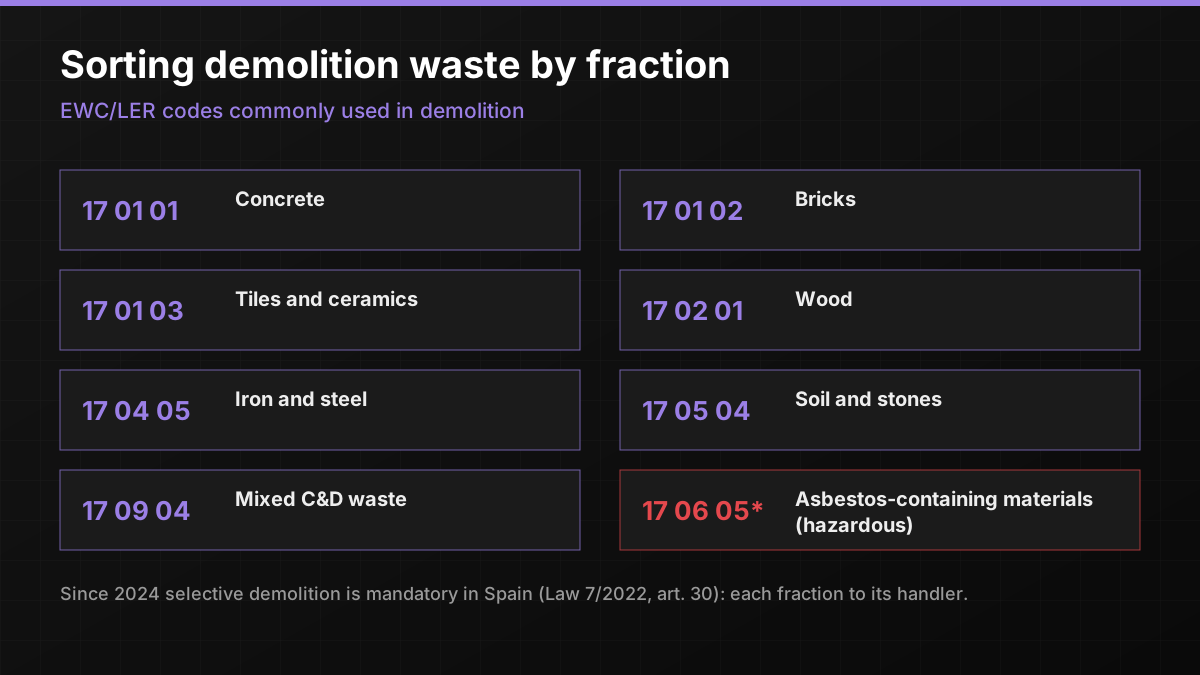
Since 1 July 2022 Spanish waste law (Ley 7/2022, art. 30.2) requires non-hazardous construction and demolition waste to be sorted at least into wood, mineral fractions (concrete, bricks, tiles, ceramics, stone), metals, glass, plastic and plaster, and reusable elements to be set aside. Selective demolition has been mandatory since 1 January 2024.
Sorting is not only a legal requirement but also the main lever on disposal cost. Clean fractions such as concrete (17 01 01), bricks (17 01 02) or iron and steel (17 04 05) can go to recycling, while mixed construction and demolition waste (17 09 04) is more expensive to manage. That is why we sort on site as the work progresses, as the photo above shows, rather than loading everything into the same container. The guide on EWC/LER codes for demolition waste lists the codes and what belongs under each.
Do you need a permit for a skip on the street?
Yes, a skip, a lorry or scaffolding standing on the public road needs an authorisation to occupy it, and each ayuntamiento sets its own procedure and fees. Benalmádena, for example, does not allow skips or materials on the public road without a permit under its fiscal ordinance.
Before work starts, check with the ayuntamiento which procedure applies to the works themselves (declaración responsable or licence) and, if there will be a container or scaffolding in the street, the occupation of the public road. We tell you in the quote whether the job needs a container in the street and coordinate the dates, but the authorisation is the owner's procedure. Where the plot has enough space, keeping the skip inside avoids the issue altogether, which is worth asking about when you compare offers.
Delivery receipts and the waste deposit
Every load we take away is delivered to an authorised facility, and you receive the delivery receipts (justificantes de entrega). Those documents are what proves the waste was managed correctly, and they have a direct financial value for you.
In Andalusia the town hall requires a fianza or guarantee for construction and demolition waste. The amount depends on each municipal ordinance, and it is returned once delivery to an authorised manager is proven, which is exactly what the receipts do. Without them, recovering the deposit becomes difficult. Your técnico also needs them: under Real Decreto 105/2008, the project includes a waste management study and the contractor prepares a waste management plan. The guide waste management costs and deposits explains the process step by step.
How do you estimate the volume and get a quote?
For rubble already on site, count or estimate the skips it would fill and use the rubble tab of the calculator. If you are unsure, photograph the piles with a person or a car for scale and tell us what they contain: concrete, bricks, tiles, soil, timber, plaster or a mix.
For rubble produced by a demolition or a strip-out, there is no need to estimate it separately: it is part of the demolition quote. The interior case is covered in interior demolition cost, and the article costs owners wish they'd budgeted for lists the waste items owners most often forget, such as soil from foundations or old rubble buried in the garden.
When you send the request, add where a skip or lorry could stand, the width of the access and whether the waste is inside a building or outdoors. Those three details change the loading time more than the quantity itself. If you live abroad, a short video walking from the street to the rubble is often the quickest way to show all of them at once.
Frequently asked questions
What affects the cost of rubble removal?
Volume and weight, the type of material, how well it is sorted, how far it has to be carried to the container, the number of trips and the distance to an authorised facility.
Is a skip or rubble bags cheaper?
Bags suit small quantities and places where a skip cannot stand; for larger volumes a skip or direct loading onto a lorry is usually more efficient.
Why is mixed rubble more expensive?
Mixed construction and demolition waste is harder to recycle and more expensive to manage than clean, sorted fractions such as concrete or bricks.
Do I need permission to put a skip on the street?
Yes, occupying the public road with a skip, lorry or scaffolding needs authorisation from the ayuntamiento. It is the owner's procedure; we flag it in the quote.
Can uralita go in the rubble skip?
No. Asbestos cement is hazardous waste and must be removed and disposed of separately by a RERA-registered company.
Will I get proof of where the rubble went?
Yes, you receive the delivery receipts from the authorised facility for the waste we take away.
Why do I need the waste delivery receipts?
They prove correct management of the waste, which the town hall needs to return the waste deposit and which your técnico needs for the documentation.
Can you remove rubble left by another builder?
Yes. Send photos of the piles with something for scale and tell us what they contain so we can assess sorting and loading.
Does soil from foundations count as rubble?
It is a separate fraction, soil and stones (17 05 04), and it is heavy; mention it so it is included in the quote.
How do I estimate how many skips I need?
Photograph the material with a person or car for scale and describe what it is; we estimate the volume from that. The calculator's rubble tab works by number of skips.