In short
Demolition waste is priced by tonnage, sorting quality and distance to an authorised facility: clean, separated fractions cost less to deliver than mixed rubble. Since 2024 selective demolition is mandatory in Spain, so sorting is part of every job. Separately, the ayuntamiento requires a waste deposit (fianza o garantía) whose amount depends on its ordinance and which is returned once delivery to an authorised manager is proven with the delivery receipts.

Contents
- Why is waste often the largest variable in a demolition price?
- What does Spanish law require for demolition waste?
- Which waste fractions does a demolition produce?
- Skips, lorries or on-site crushing: how transport changes the cost
- How does the waste deposit work in Andalusia?
- Why are delivery receipts worth keeping?
- How can you lower waste costs legitimately?
- How is asbestos waste priced and documented?
- Frequently asked questions
Why is waste often the largest variable in a demolition price?
Waste is the part of a demolition that scales most directly with the property: every tonne that comes down has to be sorted, loaded, transported and delivered to an authorised facility, and each of those steps costs time and money. Taking the structure down is a matter of days; dealing with what it leaves can take as long.
Three variables decide the waste line in a quote:
- Tonnage. A concrete-framed villa produces far more weight than a light single-storey house with the same footprint, and a basement adds a great deal more.
- Sorting quality. Clean fractions such as concrete, brick or metal are cheaper to deliver than a mixed load, and some can be recycled into aggregates.
- Distance and transport. The number of trips, the size of vehicle the access allows and the distance to the facility all add up.
This is why an honest quote cannot give a waste figure without seeing the building: the same floor area can produce very different volumes and mixtures.
What does Spanish law require for demolition waste?
Under Ley 7/2022 de residuos y suelos contaminados, non-hazardous construction and demolition waste has had to be sorted since July 2022 at least into wood, mineral fractions (concrete, bricks, tiles, ceramics, stone), metals, glass, plastic and plaster or gypsum, with reusable elements set aside. Since 1 January 2024 selective demolition is mandatory. Hazardous substances, and asbestos in particular, must be handled safely and never mixed with other waste.
The paperwork follows Real Decreto 105/2008. The project includes an estudio de gestión de residuos, prepared on the promotor's side by the técnico. The contractor, as holder of the waste, prepares a plan de gestión de residuos, approved by the dirección facultativa. Waste from minor domestic repair works counts as household waste and follows a different path.
For you as owner, the practical result is that sorting is no longer optional and has to be priced in. A quote that ignores it is either incomplete or relying on mixed loads that may cost more at the facility.
Which waste fractions does a demolition produce?
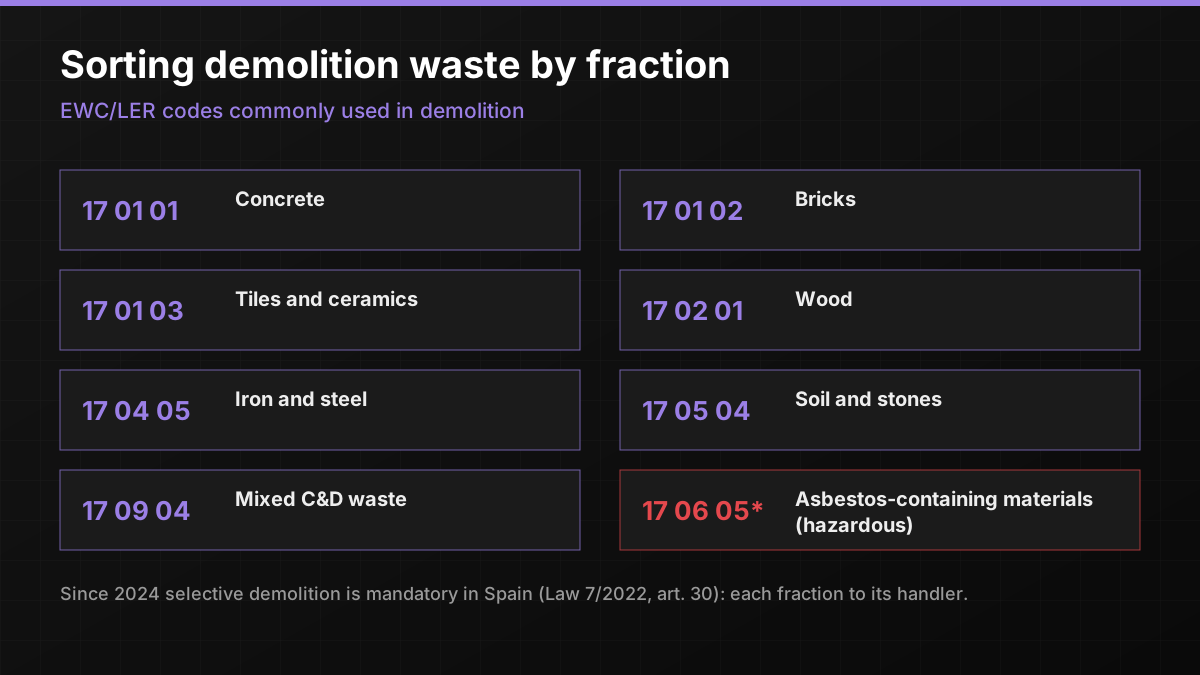
Each fraction has its own code in the European waste list (LER, known in English as EWC codes), and the delivery receipts use those codes. The ones a typical demolition in the provincia de Málaga produces are these:
| LER code | Fraction | Where it comes from |
|---|---|---|
| 17 01 01 | Concrete | Slabs, beams, columns, foundations, terraces |
| 17 01 02 | Bricks | Walls and partitions |
| 17 01 03 | Tiles and ceramics | Roof tiles, floor and wall tiles, sanitaryware |
| 17 01 07 | Mixtures of concrete, bricks, tiles and ceramics | Mineral rubble that cannot be separated further |
| 17 02 01 / 17 02 02 / 17 02 03 | Wood / glass / plastic | Roof timbers, doors, windows, pipes, fittings |
| 17 04 05 | Iron and steel | Reinforcement, beams, railings, gates |
| 17 05 04 | Soil and stones | Excavation of foundations and the ground |
| 17 08 02 | Gypsum-based construction materials | Plaster, plasterboard, false ceilings |
| 17 09 04 | Mixed construction and demolition wastes | Whatever cannot be sorted |
| 17 06 05* | Construction materials containing asbestos | Uralita roofs, pipes and tanks – hazardous |
The fewer loads that end up as mixed waste, the better for the price. Our sister site explains each code in more depth in EWC/LER codes for demolition waste.
Skips, lorries or on-site crushing: how transport changes the cost
How the waste leaves the site depends on volume and access. Small jobs and tight streets work with skips; larger demolitions with good access use lorries loaded directly by the excavator; very large concrete volumes can make on-site crushing worth considering, so that part of the material is processed before it travels.
- Skips suit interior strip-outs and small outdoor jobs, but each one is a separate delivery and collection, and if it stands on the street it needs a road occupation authorisation.
- Lorries carry more per trip and are loaded faster, but need room to manoeuvre and a surface that can take the weight.
- Crushing only makes sense above a certain volume of clean concrete and brick and on sites with space for the crusher.
The page rubble and skip cost covers jobs where the waste is the main item, and industrial demolition cost the warehouse and concrete case where crushing becomes relevant.
How does the waste deposit work in Andalusia?
The ayuntamiento requires a deposit or guarantee (fianza o garantía) for construction and demolition waste, and returns it once delivery to an authorised manager is proven. The amount depends on each municipal ordinance; it has been confirmed in the ordinances or forms of Mijas, Vélez-Málaga and Rincón de la Victoria, under the framework of Ley 3/2023 de Economía Circular de Andalucía and Decreto 73/2012, which still applies as amended.
In practice the sequence looks like this:
- The técnico's waste study estimates the waste the job will produce.
- The owner pays or guarantees the deposit with the ayuntamiento as part of the municipal procedure.
- The contractor sorts, transports and delivers the waste and collects the delivery receipts.
- The receipts are handed over and submitted to prove correct delivery.
- The ayuntamiento returns the deposit according to its own procedure.
We do not quote deposit amounts because they are set locally. Our sister site covers the municipal side in waste deposits in Andalusia.
Why are delivery receipts worth keeping?
The delivery receipts (justificantes de entrega) are the only proof that your demolition waste reached an authorised facility, and without them recovering the deposit becomes difficult. They show the waste code, the quantity and the facility that received it.
On our jobs the receipts are collected for every load and handed over at the end, together with the final photos. If you live abroad, ask for digital copies to be sent to you and to your técnico at the same time, so the waste file can be closed without anyone having to travel. Asbestos waste, removed by our RERA-registered subcontractor, has its own documentation and is never mixed with the rest.
How can you lower waste costs legitimately?
You cannot skip waste handling, but you can make it cheaper by giving the crew cleaner material and less of it. The measures below work without cutting corners:
- Empty the property first. Furniture, appliances, clothes and household items are not demolition waste; clearing them beforehand keeps the rubble clean.
- Separate garden waste. Branches and green waste mixed into rubble spoil a mineral load.
- Declare asbestos early. An asbestos element found halfway through can contaminate other fractions and stop the job.
- Allow time for selective demolition. Stripping wood, metal and plaster before the main demolition takes longer but produces cleaner fractions.
- Combine jobs. Demolishing a house, a pool and a terrace together uses the same machinery and transport.
The calculator includes a rubble-only tab for waste already on site, and the guide how a demolition quote is built shows where waste sits in the total. For a binding figure, use the quote page.
How is asbestos waste priced and documented?
Asbestos waste is priced and documented separately from the rest of the demolition waste, because it is hazardous and may not be mixed. Its code is 17 06 05*, construction materials containing asbestos, and it follows its own route from the site to an authorised manager.
Only a company registered in the RERA may remove it, under a plan de trabajo approved by the labour authority of the province. Real Decreto 847/2026, in force since late October 2026, sets the current rules and replaced Real Decreto 396/2006, which is no longer in force. In our jobs the RERA-registered company works as our subcontractor: it prepares and files the plan, removes and packages the material and delivers it, while we coordinate the rest of the demolition around that phase.
For your budget, that means the asbestos line covers removal, packaging, transport and delivery of a hazardous waste stream, and its size depends on quantity, position and access rather than on the size of the house. The page asbestos removal cost explains these factors in detail.
Sources
Frequently asked questions
Why is waste so expensive in a demolition?
Because every tonne has to be sorted, loaded, transported and delivered to an authorised facility. Tonnage, sorting quality and distance decide the cost.
Is sorting demolition waste mandatory in Spain?
Yes. Since July 2022 non-hazardous construction and demolition waste must be sorted into basic fractions, and since 1 January 2024 selective demolition is mandatory.
What is the waste deposit or fianza?
A deposit or guarantee the town hall requires for construction and demolition waste. It is returned once delivery to an authorised manager is proven.
How much is the waste deposit in Málaga province?
It depends on each municipal ordinance. We do not give amounts; your técnico or the ayuntamiento can confirm the figure.
Who prepares the waste management plan?
The contractor prepares the plan de gestión de residuos, based on the estudio de gestión de residuos that the técnico includes in the project.
What does LER 17 09 04 mean on a receipt?
Mixed construction and demolition waste, meaning material that could not be sorted. The more of it there is, the more the delivery usually costs.
Can asbestos go in the same skip as the rest?
No. Asbestos waste (17 06 05*) is hazardous, may never be mixed and is handled separately by a RERA-registered company.
Do I get the waste receipts if I live abroad?
Yes, they can be sent digitally to you and your técnico at the end of the job, together with the final photos.
Is it cheaper to use skips or lorries?
It depends on volume and access. Skips suit small jobs and narrow streets; lorries carry more per trip where they can reach the site.
Can demolition concrete be recycled?
Clean concrete and brick can be crushed into recycled aggregate at an authorised facility or, on large jobs with space, on site.