
In short
Cost per m² divides the price of a demolition by a surface, usually the built floor area, so it hides the factors that really drive cost: structure, floors, basement, access and waste. It is useful to compare similar jobs; for a binding figure, an itemised fixed-price quote is safer.
Contents
- What does a demolition cost per m² actually measure?
- Which square metres: built area, footprint or plot?
- Why does the demolition price per m² vary so much?
- Price per m² or fixed price: which is better?
- Per-m² units for slabs, walls, interiors and pools
- How to use a per-m² figure without being misled
- Frequently asked questions
What does a demolition cost per m² actually measure?
A demolition cost per m² is the total price of a job divided by a surface. Everything depends on which surface and which total: built floor area or footprint, with or without waste disposal, before or after VAT, with or without the asbestos phase and the clearing of the plot.
Used carefully, the figure helps you compare jobs of the same kind. Used on its own, it can lead you to expect the same price for a single-storey brick house on an open plot and a three-storey concrete villa with a basement on a hillside, which share nothing except the unit. The guide why demolition cost per m² can mislead covers the most common traps in detail.
Which square metres: built area, footprint or plot?
For buildings, the useful measure is the built floor area to be demolished, meaning the sum of all floors. The footprint is only the ground the building covers, and the plot is the whole parcel, which has nothing to do with demolition cost unless there is also clearing to do.
| Measure | What it is | Use for demolition |
|---|---|---|
| Built floor area | All floors added together, as in the catastro or plans | Main basis for houses and buildings |
| Footprint | The ground area the building occupies | Slabs, foundations, industrial buildings |
| Plot area | The whole parcel | Only for cleaning and basic levelling after the demolition |
| Face area | Length times height of a wall | Garden and boundary walls, partitions |
| Shell area | Floor plus walls of a pool vessel | Built pools |
When two quotes give a per-m² price, check that both use the same measure. A price per m² of plot and a price per m² of built area cannot be compared at all.
Why does the demolition price per m² vary so much?
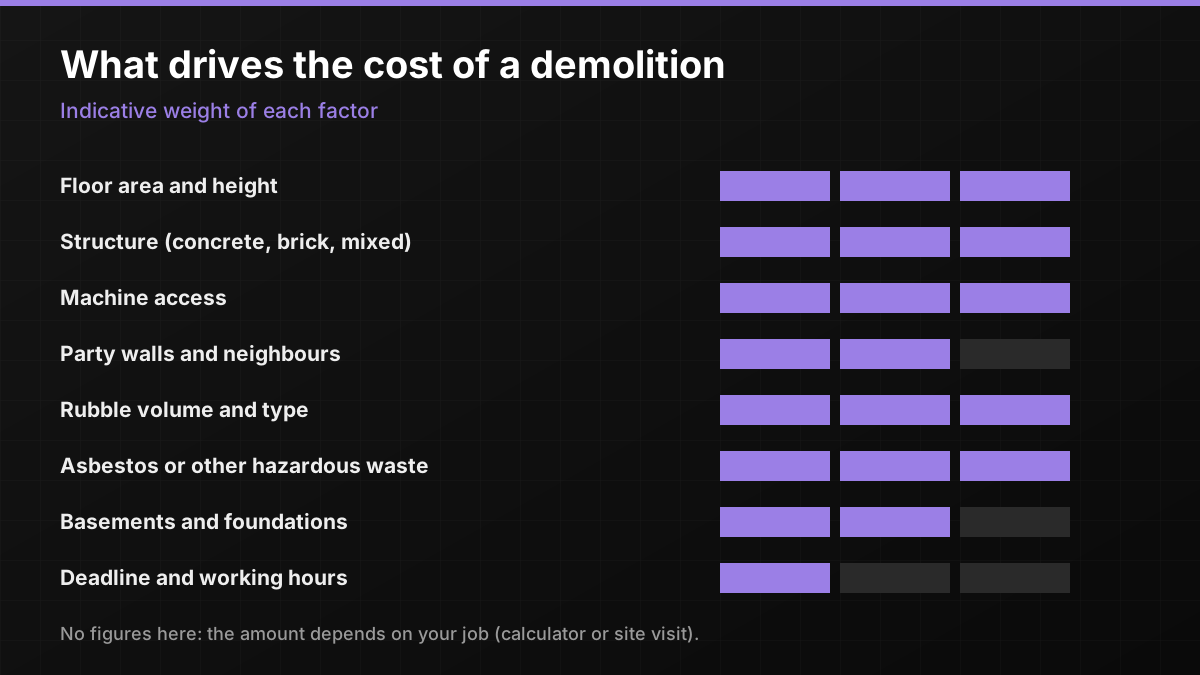
The per-m² figure moves with everything that makes each square metre harder or easier to demolish and dispose of. The main drivers are:
- Structure: reinforced concrete frames and slabs need heavier machinery and produce more tonnes of waste than load-bearing brick with a timber roof.
- Floors and height: taller buildings may need long-reach machinery or a top-down method.
- Basement and foundations: a basement adds walls, a slab and often retaining work that the floor area above ground does not show.
- Access: where only a mini excavator or hand work is possible, each square metre takes longer and waste leaves in smaller loads.
- Neighbours: shared walls, nearby buildings or a busy road require protection and slower work.
- Waste: clean, sortable rubble costs less to manage than mixed material, and asbestos is a separate phase altogether.
- Size of the job: fixed costs such as moving machinery and setting up the site are spread over fewer square metres on a small job, so small jobs have a higher per-m² figure.
The last point surprises many owners: a garage or a small outbuilding almost always has a higher cost per m² than a large villa, simply because the same mobilisation is spread over a much smaller area.
Location inside the province plays a smaller but real part as well. A site in a village of the Serranía de Ronda or the Axarquía, reached by narrow mountain roads, means longer trips to an authorised waste facility and more time moving machinery than a plot beside a main road near Málaga or Marbella. None of this is visible in a figure per square metre, which is why the same rate cannot be applied across the whole provincia de Málaga.
Price per m² or fixed price: which is better?
For most residential demolitions a fixed price for a clearly defined scope protects the owner better than a per-m² rate. A fixed price tells you what you will pay for what is written; a per-m² rate leaves the final total open to how the surface is measured once work starts.
Per-m² pricing still has a place. It is practical when the quantity is genuinely uncertain, for example floor tiles in a building where some rooms may be kept, or slabs whose extent is only known once the surface is uncovered. In those cases the quote should state the unit price, how the quantity will be measured and who signs off the measurement. The post price per m² vs fixed price for demolition compares both approaches with examples.
Per-m² units for slabs, walls, interiors and pools
Outside whole buildings, square metres are a natural unit, and the calculator uses them. Each unit, though, carries assumptions you should be aware of.
- Slabs and terraces: priced by surface, but thickness and steel mesh change the effort and the tonnage. The calculator distinguishes unreinforced and mesh-reinforced slabs up to 10 cm; thicker or heavily reinforced concrete needs a quote.
- Walls: priced by face area for a given thickness; retaining walls and walls holding up soil are a different job.
- Partitions and tiles: priced by surface inside homes, but the floor level and the way rubble leaves the building can weigh as much as the square metres.
- Pools: priced by shell area rather than water surface, because it is the concrete that has to be broken.
For the cost logic of whole houses, see house demolition cost; for interiors, interior demolition cost.
How to use a per-m² figure without being misled
Treat any per-m² number as a starting point and ask what sits behind it. Four questions are enough to make it comparable:
- Which surface is it based on, and how was it measured?
- Does it include sorting, loading, transport and delivery of the waste to an authorised facility?
- Does it include the foundations, the slab and the clearing of the plot, or only the building above ground?
- Is VAT included, and at which rate?
If a contractor can answer all four in writing, the per-m² figure becomes useful. If not, it is a sales argument. The calculator applies the factors above to your own measurements, which is a better first estimate than a generic per-m² rate found online, and the guide how to compare demolition quotes shows how to line up offers that use different units.
Frequently asked questions
Is demolition priced per square metre in Spain?
Many contractors use cost per m² as a reference, but a serious quote for a whole building is normally a fixed price for a defined scope, sometimes with unit prices for uncertain quantities.
Which square metres should I use for a house?
The built floor area to be demolished, adding up every floor. The plot area does not measure demolition work.
Why is the cost per m² of a small shed higher than a villa?
Because moving machinery and setting up the site cost roughly the same for both, and on a small job that cost is spread over far fewer square metres.
Does a basement change the cost per m²?
Yes, often a lot: it adds walls, a slab, more concrete waste and sometimes retaining work that does not appear in the floor area above ground.
Is the per-m² figure the same for brick and concrete?
No. Reinforced concrete needs heavier machinery and produces more tonnes of waste per square metre than load-bearing brick.
Should waste disposal be included in the per-m² price?
It should be stated either way. Compare only per-m² figures that include the same waste handling.
How is a pool measured for demolition?
By the area of the shell, floor plus walls, because that is the concrete to be broken. The water surface underestimates the work.
Can a per-m² quote end up higher than expected?
Yes, if the measured quantity grows once work starts. That is why the quote should say how the quantity is measured and who agrees it.
Is VAT included in per-m² figures I see online?
Often it is not clear. Always check, and compare offers net of VAT.
Where can I get a per-m² based estimate for my job?
The calculator uses your square metres together with floors, access, basement and uralita to return a range before VAT.