
In short
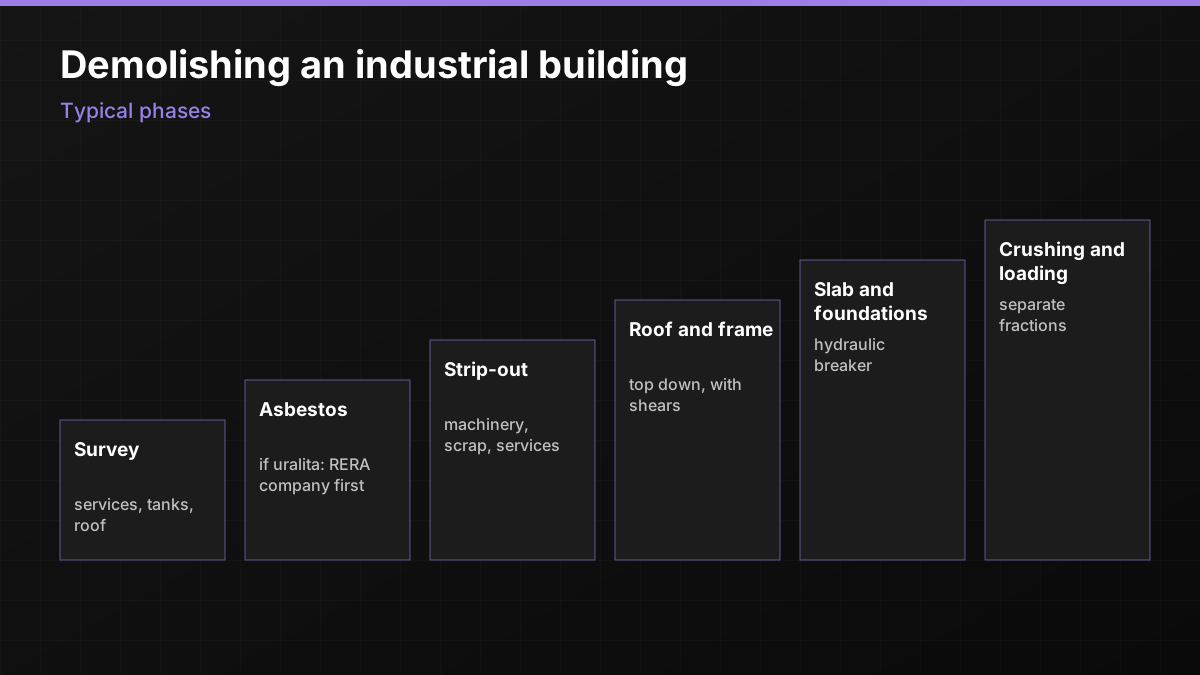
Industrial demolition is priced on the footprint and structure (steel frame or mixed steel and concrete), the roof material, whether the slab and foundations come out, the tonnage of concrete and steel, and whether crushing on site makes sense. A uralita roof adds a separate asbestos phase before anything else.
Contents
What drives the cost of demolishing a warehouse?
A warehouse demolition is priced on its footprint, its structure, its roof, the slab and foundations, and the tonnage and type of waste. Height matters too: a two-storey concrete building or a tall steel hall may need long-reach machinery and a top-down method, while a low agricultural shed comes down quickly with a standard excavator and shears.
Industrial sites add their own factors: old installations (electrical cabinets, compressors, tanks), leftover stock or materials inside, and sometimes contamination from previous activity that must be dealt with separately. The cleaner and emptier the building when we arrive, the more the cost reflects only the structure itself.
Location on the plot is another factor that owners tend to underestimate. A warehouse standing alone on an industrial estate, with a yard for machinery and lorries, is the simplest case. A building that shares a wall with an active business, stands on the boundary with a road or sits within a farm still in use needs protection, a careful sequence and sometimes work outside normal hours, all of which affect the price. For the technical phases, see warehouse and industrial demolition on our sister site.
Steel frame or concrete: how the structure changes the price
The calculator distinguishes two structures because they behave differently on site and in the waste stream.
| Structure | Typical method | Main waste |
|---|---|---|
| Steel frame with light cladding | Cladding and roof off first, frame cut and brought down with shears | Iron and steel (17 04 05), cladding panels, some concrete from bases |
| Mixed steel and concrete | Concrete crushed or broken in sequence, steel separated | Concrete (17 01 01), steel, mixed mineral fractions |
| Reinforced concrete frame | Crusher or shears, often top-down; quote required | Large tonnage of concrete with embedded steel |
Light steel buildings produce relatively little tonnage per square metre, and the steel is separated as its own fraction. Concrete buildings produce many more tonnes, and the method has to be planned around neighbouring buildings and dust control. The photo on this page shows a crusher on a reinforced concrete building with water spray to keep dust down.
Concrete slab removal and foundations
The concrete slab removal cost depends on thickness, reinforcement and what lies underneath. A thin, unreinforced slab can be broken and loaded quickly; a thick industrial floor with steel mesh or bars, or ground beams and footings, needs a hydraulic breaker and produces much more waste.
In the calculator, the slab is an option in the industrial tab, and outdoor slabs up to 10 cm have their own fields in the outdoor tab. Anything thicker, heavily reinforced or with foundations below is priced from a quote. Ask yourself whether the slab needs to come out at all: if the next project reuses it, or only needs part of it removed, the saving is real. Your técnico can tell you what the new project requires.
Foundations deserve a separate word. Below a warehouse there may be pad footings under each column, ground beams linking them and, in older buildings, pits for machinery or tanks. None of this is visible before the slab is broken, so the quote should say how foundations are treated: removed completely, removed to a given depth or left in place, and how any extra concrete found below ground is measured and priced.
Is crushing concrete on site worth it?
Crushing concrete on site with a mobile crusher turns demolition rubble into recycled aggregate that can be reused, for example as fill or sub-base, and reduces the number of lorries leaving the site. It pays off when there is a large volume of clean concrete and a use for the aggregate on the same plot or project.
On small jobs, bringing a crusher to site costs more than it saves, and the rubble is better sent to an authorised facility. The concrete crushing cost therefore only makes sense in the context of the whole job: volume, space for the machine, neighbours and what the aggregate will be used for. Our sister site discusses it in is site crushing worth it?, and the post cheap vs expensive demolition quotes shows how such choices explain differences between offers.
Uralita roofs on industrial buildings
Many warehouses, workshops and farm buildings in the provincia de Málaga have corrugated fibre cement roofs. Where these contain asbestos, they are removed first by a RERA-registered company working as our subcontractor, under its own approved work plan, and only then does the demolition of the structure begin.
On a large roof this phase can be a significant part of the total, which is why the calculator has a separate uralita option for industrial buildings. Height, roof condition and whether the sheets can be lowered whole are the factors that weigh most. See asbestos removal cost for the details of that phase.
Health and safety, documentation and what to send
Industrial demolitions usually involve more documentation than a house. Under Real Decreto 1627/1997, each job has an estudio de seguridad y salud or an estudio básico, depending on budget, duration and workforce, prepared within the technical documentation; the contractor prepares its plan de seguridad y salud from it. When several companies or self-employed workers take part, for example an asbestos subcontractor and the demolition team, the promotor appoints a coordinador de seguridad y salud during execution. Those documents are produced by a técnico competente engaged by the owner and sit outside our price.
For a quote, send the footprint and height, photos of the structure, roof, slab and access, any plans you have, and a description of what is still inside the building. The guide how a demolition quote is built explains how these details become lines in the offer.
Frequently asked questions
How much does it cost to demolish a warehouse?
It depends on footprint, height, structure, roof material, slab and foundations, and waste tonnage. The industrial tab of the calculator gives a range before VAT.
Is a steel warehouse cheaper to demolish than a concrete one?
Usually yes: a light steel frame produces less tonnage and comes down faster than reinforced concrete.
What affects concrete removal cost?
Thickness, reinforcement, what lies underneath, access for a breaker and the tonnage to be transported.
Does the slab have to be removed?
Not always. If the next project can reuse it, or only part needs removing, ask your técnico; removing less concrete reduces cost.
Is concrete crushing on site always cheaper?
No. It pays off with large volumes of clean concrete and a use for the aggregate; on small jobs an authorised facility is more economical.
What happens to the steel from a warehouse?
It is separated on site as its own fraction, iron and steel (17 04 05), and delivered for recycling.
Does a uralita roof change the schedule?
Yes, it is removed first by a RERA-registered subcontractor under an approved work plan, before the structure is demolished.
Who prepares the safety documentation for an industrial demolition?
The estudio de seguridad y salud or estudio básico is part of the technical documentation by a técnico competente; the contractor prepares its safety plan from it.
Should the building be empty before you arrive?
Ideally yes. Leftover stock, machinery or materials inside add sorting and disposal work that has to be priced separately.
Can you demolish part of an industrial building and keep the rest?
Yes, partial demolition is possible with the right method and your técnico's design for what remains.