
In short
The cost to demolish a house is driven by built floor area and floors, structure, basement and roof, access and neighbours, what else is on the plot (pool, outbuildings, walls, uralita), waste volume and sorting, and the finished condition of the plot. The técnico's documentation and municipal procedure are separate costs.
Contents
- How much does it cost to demolish a house?
- The building: floors, structure, basement and roof
- The plot and its surroundings: access, slope and neighbours
- What else is on the property: pool, outbuildings, walls and uralita
- Paperwork and other items in your demolition budget
- Demolish or renovate: cost is only one side
- Building a realistic house demolition budget
- Frequently asked questions
How much does it cost to demolish a house?
The cost to demolish a house is the sum of four blocks: the building itself, the plot and its surroundings, everything else on the property, and the finishing of the site. Each block can weigh more or less depending on the property, which is why two villas of the same size can produce very different demolition prices.
For a first figure, the house tab of the calculator takes the built floor area, floors, access, basement and uralita and returns a range before VAT. The rest of this page explains what that range cannot see and what the written quote then adds. If you want a worked example for the coast, read how much it costs to demolish a villa on the Costa del Sol in 2026.
The building: floors, structure, basement and roof
The building sets the base of the price. What counts is how much material there is and how hard it is to bring down safely.
- Floors: more floors means more volume, and above a certain height a different method or longer-reach machinery.
- Structure: traditional load-bearing brick with timber or ceramic floors comes down differently from a reinforced concrete frame, which produces more tonnes and needs a crusher or breaker.
- Basement: adds walls, a slab and soil-retaining issues that the floor area above ground does not reflect; often the single largest correction to a first estimate.
- Roof: tiles and timber are sorted into their own fractions; a uralita roof means an asbestos phase first.
- Condition: a building in poor condition may need propping or demolition from a distance with machinery rather than standard sequencing.
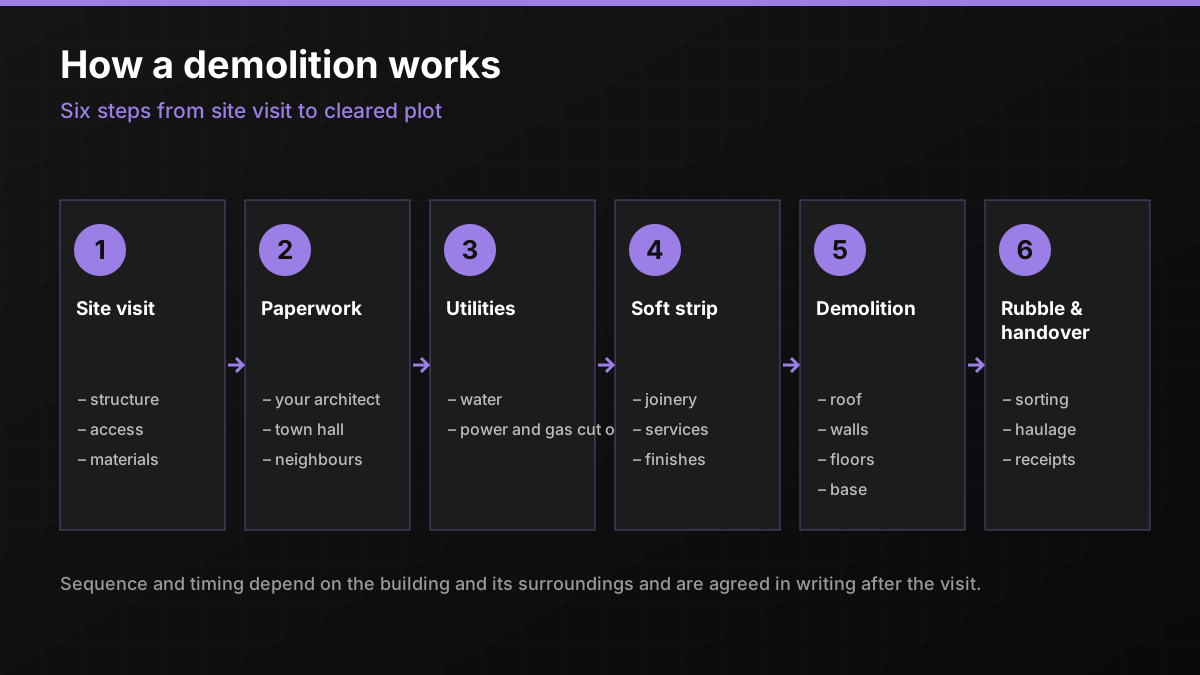
The sequence documented on our projects page, a single-storey brick house before, during and after, is typical of a straightforward case: the tiled roof and timber are separated first, the brick follows, and the plot is cleared at the end.
The plot and its surroundings: access, slope and neighbours
Where the house stands can change its demolition cost as much as its size. A detached villa on a flat plot with a wide gate lets a standard excavator and lorries work freely. A house on a hillside urbanización, in a village street too narrow for a lorry, or in a dense urban area with buildings on both sides calls for smaller machinery, more manual work, protection of neighbours and more trips.
The aerial photo on this page shows the second kind of case: an old villa being demolished in a built-up setting, where every movement of the machine has to account for the buildings around it. Shared or party walls are the most delicate point: the wall that stays must remain stable and weatherproof, which may require your técnico's instructions and extra work. If a skip or lorry has to stand in the street, an authorisation to occupy the public road is needed.
What else is on the property: pool, outbuildings, walls and uralita
Most houses come with more than the house. Each additional element adds to the job, but demolishing them together is usually more economical than handling them separately later.
- a pool, removed completely or filled in, see pool removal cost;
- garages, storerooms, pool houses, porches and pergolas;
- terraces, patios, driveways and paths, often with a slab underneath;
- boundary and garden walls, fences and gates;
- water tanks, cisterns and septic tanks;
- uralita roofs or fibre cement elements, removed first by a RERA-registered subcontractor, see asbestos removal cost.
List everything in your request, including what you want to keep. A garden wall shared with a neighbour, a tree you value or paving you want to reuse changes the method and the protection needed.
Paperwork and other items in your demolition budget
A complete demolition budget includes items paid to other people besides the contractor. Planning them from the start avoids a total that grows after you have signed.
A técnico competente engaged by you prepares and signs the technical documentation: the proyecto or memoria técnica, the safety study and the waste management study. In Andalusia, demolishing a building that is not protected has been done by declaración responsable since 2024, while protected buildings, protected settings and archaeological zones still need a licencia urbanística; in a conjunto histórico such as those of Ronda, Antequera or Vélez-Málaga, expect the licence regime and possibly heritage authorisation, and confirm it with the ayuntamiento. The town hall also requires a deposit or guarantee for construction and demolition waste, returned once delivery to an authorised manager is proven.
On the contractor's side, selective demolition has been mandatory since 1 January 2024, so a proper quote includes on-site sorting rather than loading everything together. Our sister site explains the procedure in demolition permits in Andalusia.
Demolish or renovate: cost is only one side
Owners of old villas and fincas often ask whether it is cheaper to renovate or to demolish and rebuild. The demolition cost is only one element of that decision: what matters more is the condition of the structure, what the planning rules allow you to build again, and how much of the existing building a renovation could really keep.
Your técnico is the right person to compare both routes for your property. What we can give you is a reliable demolition figure to put into that comparison, including the clearing of the plot. Our sister site discusses the decision in is it worth knocking down and rebuilding?
Building a realistic house demolition budget
A realistic budget combines three things: the calculator range for the order of cost, a written quote for the binding figure, and the separate costs of the técnico, the procedure and the waste deposit. Keep a reserve for what nobody can see beforehand, such as buried rubble, unexpected foundations or a tank under the garden, and check how the quote treats those findings.
When you compare offers, line them up by scope, method, waste and exclusions before looking at the total, as described in how to compare demolition quotes. Then ask for yours through the demolition quote request, with photos of every side of the house and the access.
Frequently asked questions
How much does it cost to demolish a house in Spain?
It depends on floor area, floors, structure, basement, access, what else is on the plot and the finished condition of the site. The house tab of the calculator gives a range before VAT.
Is it more expensive to demolish a concrete house than a brick one?
Usually yes: reinforced concrete produces more tonnes of waste and needs a crusher or breaker.
How much does a basement add?
It can be the largest correction to a first estimate because it adds walls, a slab and soil-retaining work. Tick the basement option in the calculator and mention it in your request.
Does the price include demolishing the pool and garage?
Only if they are in the scope. List every element on the plot so the quote includes them.
Is it cheaper to demolish a house and pool together?
Generally yes, because machinery, transport and site set-up are mobilised once.
What is selective demolition?
Demolishing in an order that separates materials into fractions such as wood, concrete, bricks, metals and plaster; it has been mandatory in Spain since 1 January 2024.
What happens with a shared wall?
The wall that stays must remain stable and weatherproof. It may require your técnico's instructions and extra protection work, which the quote reflects.
Do I need a licence to demolish my house in Andalusia?
For buildings not protected, a declaración responsable has been the rule since 2024; protected buildings, settings and archaeological zones still need a licence. Confirm with the ayuntamiento.
What should I budget for besides the contractor?
The técnico's documentation, any municipal fees for the procedure (to be verified locally), the waste deposit and street occupation if a skip or lorry stands on the road.
Can you demolish my house while I live abroad?
Yes. We agree access and contacts in advance, coordinate with your técnico and send photo updates at each stage.