In short
A demolition quote combines six blocks: site set-up and mobilisation, the demolition work itself (driven by volume, structure and technique), waste sorting, transport and delivery to an authorised manager, any asbestos phase, safety and protection of neighbouring structures, and the final condition of the site. Exclusions and VAT are stated separately. Each block depends on facts about your property, which is why photos and measurements change the figure more than anything else.

Contents
- What is a demolition quote actually made of?
- How is the demolition work itself priced?
- Why do mobilisation and access appear as a separate cost?
- How is the waste part of a quote calculated?
- When does asbestos become its own line?
- What do safety and protection add to the price?
- Exclusions, VAT and how long a quote stays valid
- From the calculator range to your written quote
- Frequently asked questions
What is a demolition quote actually made of?
Every demolition quote, however it is presented, is built from the same handful of cost blocks: getting people and machinery to the site, taking the structure down, dealing with the waste, handling any hazardous material, keeping the site and its neighbours safe, and leaving the plot or room in an agreed state. The total is simply the sum of those blocks for your specific job.
Some contractors show each block as a separate line; others give a single figure with a short description. The underlying arithmetic is the same, and an itemised quote is easier to check from abroad because you can see where the money goes and question one line without reopening the whole price.
| Cost block | What it covers | What makes it larger or smaller |
|---|---|---|
| Set-up and mobilisation | Transporting machinery, fencing or taping off, site preparation, protection of what is kept | Distance, access route, size of machine, whether a crane or low-loader is needed |
| Demolition work | Taking down the structure with manual, mechanical or combined technique | Volume, number of floors, concrete versus brick, basement, party walls |
| Sorting and waste | Separating fractions, loading, transport, delivery to an authorised manager, receipts | Tonnage, how clean each fraction is, distance to the facility, skips versus lorries |
| Hazardous materials | Asbestos cement removal by a RERA-registered subcontractor before the main demolition | Quantity, position (roof, pipes, tanks), height and access |
| Safety and protection | Site safety plan, propping, nets, dust and debris control, protection of adjoining property | Proximity to neighbours and roads, height, shared walls |
| Final condition | Removal of remains, clean-up, basic levelling after demolition | What you want left: bare slab, cleared plot, ground ready for the next builder |
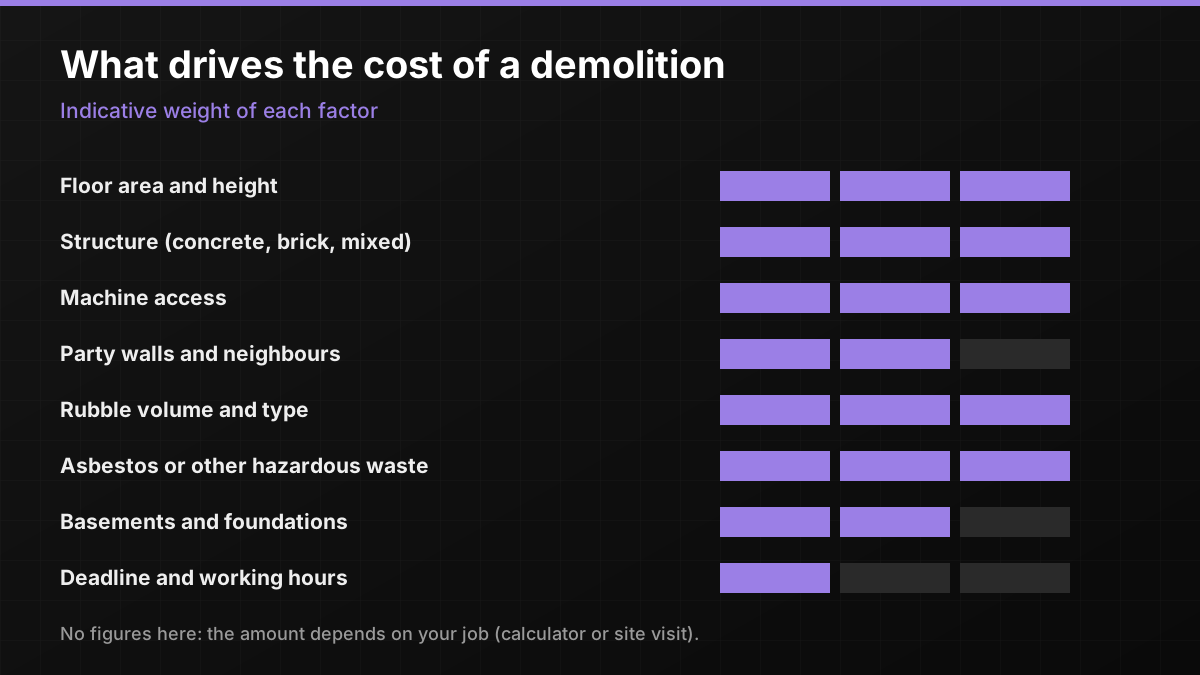
How is the demolition work itself priced?
The core of the quote is the time and equipment needed to bring the structure down safely, and that depends on three things: how much there is to demolish, what it is made of and which technique the site allows. Floor area is only the starting point.
- Volume, not just area. A two-storey villa contains roughly twice the material of a single-storey house with the same footprint, and a basement adds walls, a slab and often retaining structures below ground.
- Structure. Load-bearing brick walls with timber or light beams come down faster and produce lighter waste than a reinforced concrete frame, which needs breakers or shears and creates steel that has to be separated from the concrete.
- Technique. Mechanical demolition with an excavator is the fastest per tonne; manual demolition is slower but is the only safe option next to shared walls, inside buildings or where a machine cannot reach. Many jobs on the Costa del Sol are combined: hand work at the edges, machine work in the middle.
A contractor pricing this block is effectively estimating machine days and crew days, then adding the wear and fuel that go with them. That is why the same floor area can lead to very different figures, a point developed in why demolition cost per m² can mislead.
Why do mobilisation and access appear as a separate cost?
Mobilisation is the cost of getting the right equipment onto your site and preparing it before the first wall comes down, and it is largely fixed whatever the size of the job. On a small demolition it can be a significant share of the total; on a large one it fades into the background.
Access is the factor that owners abroad underestimate most. A villa on a wide road with an open gate can take a standard excavator and a lorry; a house at the end of a steep lane in a hillside urbanización may only accept a mini excavator, smaller loads and more trips. The quote reflects that through slower work and extra transport, not through a surcharge for its own sake.
Things that change this block in practice:
- the width of the road and of the gate, overhead cables and trees;
- whether a lorry can stop next to the site or needs a permit to occupy the public road;
- slopes, steps and retaining walls between the street and the building;
- parts of the property that must be protected, such as a pool, a garden or a neighbour's boundary.
How is the waste part of a quote calculated?
Waste is usually the most variable block, because it depends on the tonnage that leaves the site, how cleanly it can be separated and how far it has to travel. A demolition that produces clean concrete, clean brick and clean metal costs less to dispose of than one that produces a mixed heap of everything.
Spanish law now sets the method. Under Ley 7/2022 de residuos y suelos contaminados, non-hazardous construction and demolition waste has had to be sorted at least into wood, mineral fractions, metals, glass, plastic and gypsum since July 2022, and selective demolition has been mandatory since 1 January 2024. A quote that simply says "waste included" without describing sorting and delivery is incomplete by today's standard.
On our jobs the materials are sorted on site, loaded and taken to an authorised facility or manager, and you receive the delivery receipts (justificantes de entrega). Those receipts are what your técnico and the town hall need to close the waste file, and they are also the proof required to recover the waste deposit. The full picture of these costs is in waste management costs and deposits, and the page on rubble and skip cost covers jobs where only the waste has to go.
When does asbestos become its own line?
If the building has asbestos cement, commonly called uralita in Spain, it becomes a separate phase that has to be completed before the main demolition. It cannot be mixed with other waste, it has its own LER code (17 06 05*) and it is handled under different rules.
Only companies registered in the RERA may remove asbestos-containing materials, and they work under a plan de trabajo approved by the provincial labour authority. Real Decreto 847/2026, in force since late October 2026, now regulates this work and replaced the old Real Decreto 396/2006. In our jobs the asbestos removal is carried out by a RERA-registered company working as our subcontractor, which prepares and files its own work plan; we coordinate the rest of the demolition around it.
For the quote, this means a separate line whose size depends on how much material there is, where it sits and how easy it is to reach. A flat uralita shed roof at ground level is a very different job from corrugated sheets on a two-storey roof or old pipes and water tanks inside walls. The page asbestos removal cost explains these factors, and our sister site covers the procedure itself in the asbestos work plan in Spain.
What do safety and protection add to the price?
Safety is not an optional extra in a demolition quote: under Real Decreto 1627/1997 every construction or demolition job has an estudio de seguridad y salud or an estudio básico, drafted by the técnico, and the contractor prepares its own plan de seguridad y salud based on it. When several companies or self-employed workers take part, the promotor appoints a safety coordinator for the works.
The cost of this block grows with the risk around the site. A detached house in the middle of a large plot needs perimeter control and good practice; a terraced house in a town centre needs propping of party walls, protection of the neighbour's roof, nets on the street side, dust suppression and careful sequencing. Those measures take time and materials, and they belong in the quote.
Exclusions, VAT and how long a quote stays valid
The last part of a quote is often the most important: what is not included, which VAT rate applies and for how long the figure holds. Read it before the total.
- Exclusions. A contractor does not normally include the técnico's fees, the municipal procedure and any fees or taxes linked to it, the waste deposit required by the town hall, or disconnection of utilities by the supply companies. Our quotes state these exclusions explicitly; the guide what's included in a demolition quote and what isn't lists them in detail.
- VAT. Demolition work is generally taxed at the standard 21 % IVA. Certain renovation or repair works on private homes may qualify for 10 % if the conditions of the Ley del IVA are met. Each quote states the rate that applies, and the calculator shows figures with VAT not included.
- Validity. A quote is based on the conditions at the time it was prepared. If months pass before the job starts, or the scope changes, ask for it to be confirmed in writing.
From the calculator range to your written quote
The demolition calculator applies the same blocks in simplified form: it takes your measurements and the main factors and returns a rounded range before VAT. It cannot see your access, your neighbours or the state of the structure, so the range is an orientation.
The written quote replaces that range with a figure for your property. To get there, we need photos of every side of the building, the access route and the roof, plus measurements or plans; the checklist is in the information we need to quote your demolition. Send it through the quote page and you will receive an itemised offer, without obligation, in English or Spanish.
Sources
Frequently asked questions
What are the main parts of a demolition quote?
Set-up and mobilisation, the demolition work, waste sorting and disposal, any asbestos phase, safety and protection, and the final condition of the site. Exclusions and VAT are stated separately.
Why do two quotes for the same house differ so much?
Usually because they assume different techniques, different waste handling or different end conditions. Compare the scope and method line by line before comparing totals.
Is mobilisation charged on every job?
Getting machinery and crew to the site always costs something. On small jobs it weighs more in the total; on large ones it is diluted.
Does a reinforced concrete house cost more to demolish than a brick one?
Generally yes, for the same volume: concrete needs breakers or shears, takes longer and the steel has to be separated from the concrete before delivery.
Why is waste such a large part of the price?
Because it depends on tonnage, sorting quality and distance to an authorised facility, and since 2024 selective demolition is mandatory, so the sorting work is part of the job.
Is asbestos removal included in a normal demolition price?
It is a separate phase and a separate line. In our jobs it is carried out by a RERA-registered company working as our subcontractor before the main demolition.
Do I pay VAT on a demolition quote?
Yes. Demolition is generally taxed at 21 % IVA; some renovation works on private homes may qualify for 10 % if the legal conditions are met. The quote states the rate.
Are the técnico's fees part of the demolition quote?
No. The técnico is engaged by the owner and invoices separately. We work with the documentation your técnico prepares.
Can a quote change after work has started?
Only if something not foreseen in the quote appears, such as buried structures or undetected asbestos. Any change should be agreed in writing before the extra work is done.
How do I get an itemised quote from abroad?
Send photos, measurements or plans and the address through the quote page. We reply in English or Spanish with questions or an itemised offer, without obligation.