In short
A demolition should be paid in stages tied to milestones you can verify, such as the start of works, the structure down and the site cleared to the agreed condition with waste receipts delivered. The written agreement should reference the quote's scope, state the VAT rate, describe how variations are approved in writing and define the handover. Photos at each milestone let owners abroad confirm progress before paying.

Contents
- Why put a demolition agreement in writing?
- What should a written demolition agreement contain?
- How should stage payments be tied to milestones?
- What should you avoid paying upfront?
- How are extras and variations handled?
- Handover: how do you know the job is finished?
- Special cases: communities of owners and remote management
- A milestone table you can adapt
- Frequently asked questions
Why put a demolition agreement in writing?
A written agreement turns the quote into a shared reference: what will be done, when, for how much and how both sides know a stage is complete. For an owner abroad, it is also the document that replaces being on site, because every question during the job can be answered by pointing to it.
Demolition is a short, intense type of work. Decisions happen quickly, and the most common disagreements are about whether something was included, whether a stage is finished and whether an extra was approved. Each of those is easy to settle when it is written down beforehand and difficult when it is not.
This guide is practical, not legal advice: it describes what a clear agreement usually contains. If your project is large or complex, your técnico or a lawyer can review the document before you sign.
What should a written demolition agreement contain?
A clear demolition agreement covers the parties, the job, the money and the procedure for changes. The usual contents are:
- Parties and property. Names, addresses and identification of owner and contractor, and the address and cadastral reference of the property. For the municipal and tax side, the owner identifies themselves with their DNI, NIE or NIF.
- Scope. A reference to the accepted quote, including what is demolished, what is kept and the final condition of the site.
- Documentation. Who provides what: the owner and técnico handle the declaración responsable or licence and the technical documents; the contractor works from them and prepares its safety plan and waste management plan.
- Timing. An expected start window and duration, and the conditions for starting, such as utilities disconnected and the municipal procedure in place.
- Price and VAT. The total, the VAT rate that applies and the payment stages.
- Variations. How unforeseen work is reported, priced and approved before it is carried out.
- Waste. Delivery to an authorised manager and handover of the receipts.
- Communication. Language, contact person and how progress is reported.
How should stage payments be tied to milestones?
Each payment should follow a milestone that both sides can recognise without argument, ideally one that can be shown in a photo. That way the contractor is paid as the work and its costs advance, and the owner never pays far ahead of what has been done.
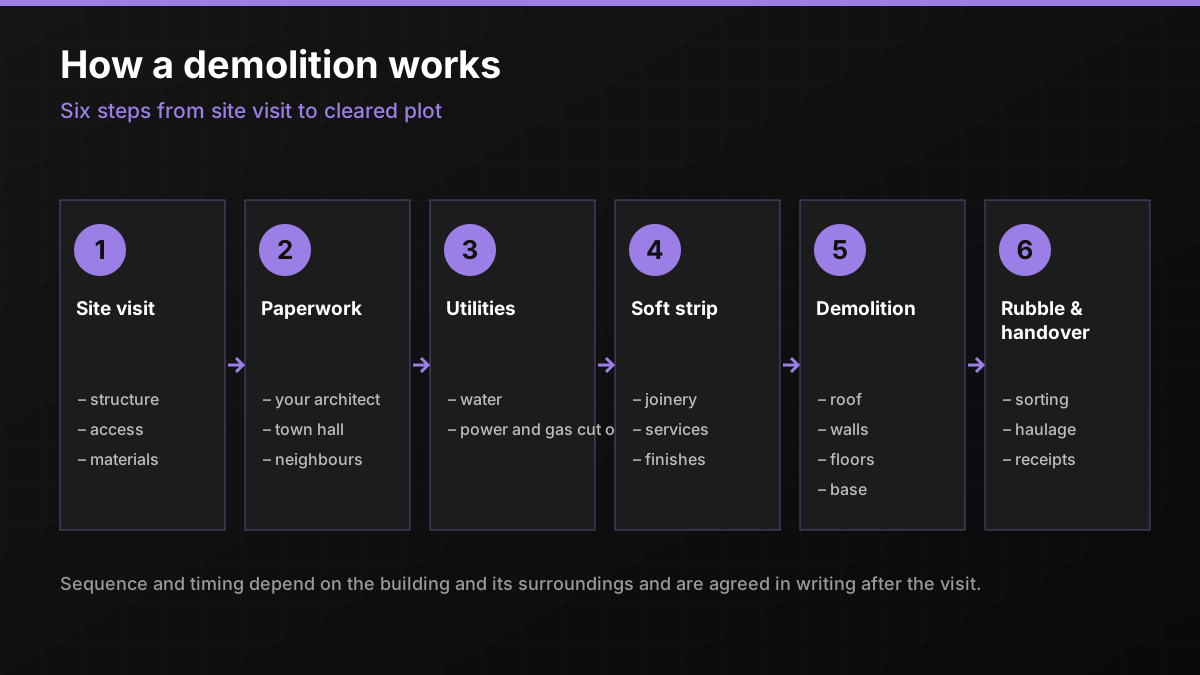
A typical sequence for a house or villa demolition looks like this:
- Booking: when the start date is fixed and the conditions for starting are met.
- Preparatory phase complete: for example once any asbestos phase has been finished by the RERA-registered subcontractor and the interior has been stripped for selective demolition.
- Structure down: when the building has been demolished and the waste is being sorted and loaded.
- Handover: when the site matches the agreed final condition and you have the waste delivery receipts.
The split between stages depends on the size and duration of the job and is agreed case by case; there is no fixed percentage that suits every demolition. Small jobs often need only two stages.
What should you avoid paying upfront?
As a rule, avoid paying a large share of the price before any work or visible milestone. A booking payment that secures the date is reasonable; paying most of the job before machinery has arrived leaves you with little leverage if plans change.
Other habits that protect both sides:
- pay by bank transfer to an account in the name that appears on the invoice;
- ask for an invoice for every payment, with the VAT rate shown;
- keep the final payment for the handover, checked against photos and the receipts;
- do not pay for extras that have not been agreed in writing first.
On our jobs, payments are invoiced with the VAT rate stated, and the stages are set out in the quote before work begins. Demolition work is generally taxed at 21 % IVA, while certain renovation or repair works on private homes may qualify for 10 % if the conditions of the Ley del IVA are met.
How are extras and variations handled?
A variation is any change to the agreed scope, either because you ask for something extra or because something unforeseen appears during the demolition. The rule that avoids disputes is simple: no variation is carried out until it has been described, priced and approved in writing.
In practice the sequence is: the crew stops work on the affected element, you receive photos and a short explanation, a price for the extra work follows, and the work continues once you have confirmed by e-mail or message. Typical causes are buried rubble, foundations deeper than expected, an unrecorded cistern or asbestos hidden in walls or under later roofing.
Variations that reduce the scope, for example deciding to keep a boundary wall, should be written down in the same way so that the final invoice reflects them.
Keep all variations in one place, numbered in order, with the photos, the price and your approval attached. At the end of the job that list, together with the original quote, explains every difference between the quoted total and the final invoice without anyone having to reconstruct a conversation.
Handover: how do you know the job is finished?
The job is finished when the site matches the final condition described in the quote and you have the documents that go with it. Defining that moment in advance is what makes the last payment straightforward.
A handover checklist for a demolition usually includes:
- photos of the site from the same viewpoints as the photos taken before the works;
- confirmation that the elements to be kept are intact;
- confirmation that no demolition waste remains on the plot;
- the waste delivery receipts, which your técnico and the town hall need, and which serve to recover the waste deposit;
- any open points written down, with a date to resolve them.
The page plot clearance cost covers how the final phase is priced, and house demolition cost the residential job as a whole.
Special cases: communities of owners and remote management
In a building under propiedad horizontal, the community of owners must be informed before walls, structure or façade elements are demolished, and works affecting common elements need the agreement of the owners' meeting. That agreement should exist before the contract is signed, and the contract can make it a condition for the start date. Our sister site explains the process for interior jobs in strip-outs in an apartment building.
If you manage the job from abroad, name a contact person in Spain if you have one, such as your técnico or a property manager, and agree in the contract who can approve variations in your absence. You can write to us in English or Spanish, and we send photo updates at the agreed milestones. For full coordination of the process, see managing a demolition from abroad, and for the step before the contract, how to compare demolition quotes. When you are ready, request a written offer through the quote page.
A milestone table you can adapt
A table that links each payment to its evidence makes the agreement easy to follow from abroad. Adapt the rows to your job; the principle is that every payment has something you can see or hold.
| Milestone | Evidence you receive | Documents that should exist |
|---|---|---|
| Booking and start date | Written confirmation of dates | Accepted quote, municipal procedure in place, utilities disconnected |
| Asbestos phase complete (if any) | Photos of the cleared elements | The subcontractor's approved work plan and the hazardous waste documentation |
| Structure down | Photos from agreed viewpoints | Safety plan in use, waste being sorted into fractions |
| Handover | Final photos matching the agreed condition | Waste delivery receipts, list of any open points |
If your técnico or a property manager visits the site, their confirmation can replace or complement the photos. The point is not bureaucracy: it is that neither side has to rely on memory when the next invoice arrives. The guide what's included in a demolition quote and what isn't helps you write the final condition precisely enough to be checked.
Sources
Frequently asked questions
How is a demolition usually paid?
In stages tied to visible milestones: booking, structure down and handover, with an extra stage for preparatory work on larger jobs. The split is agreed case by case.
Is it normal to pay a deposit before a demolition?
A booking payment that fixes the start date is common. Paying most of the price before any work has been done is not advisable.
What percentage should each stage be?
There is no fixed percentage that fits every job. It depends on size and duration, and it is agreed in writing before work begins.
How do I check a milestone from abroad?
Through photos sent at each agreed stage, taken from the same viewpoints as the photos before the works, and through your técnico if they visit.
What happens if extra work is needed?
Work on that element stops, you receive photos and a price, and the extra goes ahead only after your written approval.
Should every payment have an invoice?
Yes. Each payment should be invoiced with the VAT rate stated, and paid by transfer to an account in the invoicing name.
When should I make the final payment?
When the site matches the agreed final condition and you have received the waste delivery receipts.
Do I need the community's agreement before signing?
In a building under propiedad horizontal, works affecting common elements need the owners' meeting agreement, so it should be in place before the start date.
Can someone approve variations on my behalf?
Yes, if the contract names that person. Many owners abroad delegate to their técnico or property manager.
Is this guide legal advice?
No. It describes what a clear demolition agreement usually contains. For large or complex projects, ask your técnico or a lawyer to review the contract.